

7 Die Casting Design Mistakes That Increase Manufacturing Cost
The cost of a die-cast component is often determined long before any part ever comes off the production line. Thoughtful die casting design can reduce complexity in tooling, save material, improve casting quality and reduce machining and production costs.
A part that is ideally suited for its application can still be expensive to produce if it requires an unnecessarily complex tooling process, difficult metal flow, ejection or additional machining. In many cases minor design changes to the part geometry before tooling can drastically reduce these costs.
Your goal should not only be to design a part that performs as desired, but one that can also be consistently produced with minimal difficulty and additional machining.
Design Mistakes to Avoid for Cost-Effective Die Casting
Good die casting design requires balancing component performance with manufacturability. A part can be expensive to produce, even if it performs its intended function, when its geometry makes it difficult to cast, machine, or inspect.
Following practical die casting design guidelines can help reduce tooling, material, machining, and production costs. Here are several common design mistakes that can directly impact the die casting manufacturing cost:
Insufficient Draft Angles
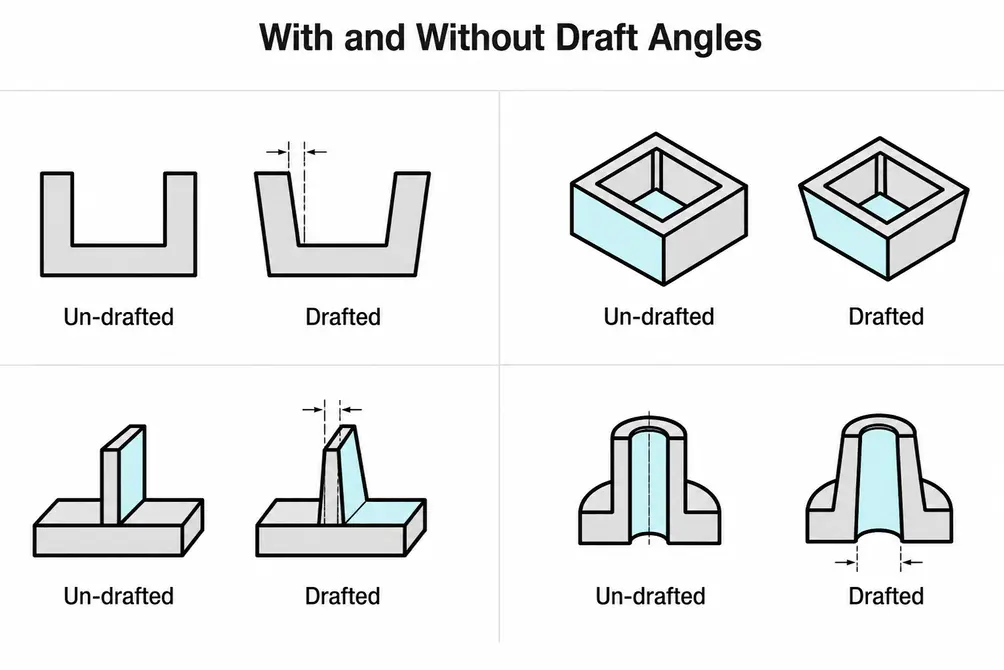
Draft is essential to facilitate removal of the component from the die without damaging the casting or subjecting the tooling to undue stress. Inadequate provision for draft can lead to problems such as sticking of the part to the die.
In addition, insufficient draft angles can necessitate time-consuming and expensive tool modifications once tool development is underway.
Draft angles for a particular casting depend on a variety of factors, including the alloy being cast, surface finish, thickness of the casting and the design of the component. It is therefore important to make sure that draft is incorporated wherever necessary to eliminate additional tooling expenses.
Design Tip: Provide adequate draft on surfaces that run parallel to the die opening direction to facilitate easy part ejection.
Inconsistent or Excessive Wall Thickness
Large variations in thickness can cause uneven metal flow and cooling thus creating a risk for defects such as shrinkage porosity.
Unnecessary thickness on walls and webs also adds extra weight to the component. Gradual transitions between different wall thicknesses can improve metal flow and reduce the risk of casting defects.
Design Tip: Avoid walls of inconsistent or excessive thickness, and provide tapers where necessary.
Unnecessary Undercuts and Features
Undercuts can make a casting more challenging to produce by necessitating the use of additional slides or cores to form the necessary projections on a component.
These additional tools add to the time and cost of production, as well as the complexity of the process.
While undercuts can make components challenging to cast, some projections and undercuts in the design would be more expensive to machine or inspect.
Design Tip: Ensure that all projecting features and undercuts are necessary by considering their impact on casting as well as on other processes such as machining, inspection and assembly.
Sharp Corners and Poor Radii
Sharp internal corners cause stress concentration in the component and are also challenging to form during the die casting process.
Radii should therefore be used wherever there are abrupt changes in cross-section of the component. Suitable radii can improve molten metal flow and reduce stress concentrations, making the component easier to manufacture.
Design Tip: Replace sharp internal corners with appropriate fillets that can ease metal flow and prevent stress concentration, especially at locations subject to load.
Tight Tolerances
Tighter dimensional tolerances can add significantly to the cost of machining, inspection, and tooling for a component, without providing any additional benefits.
The same applies to specifications for tolerances that can only be achieved on machined surfaces.
It is important to recognize that some tolerances are more critical than others depending on a component’s intended use and specify tighter tolerances only where necessary.
Design Tip: Only apply tight tolerances to surfaces and dimensions that are critical to a component’s performance.
Overlooking Secondary Operations
A die-cast component rarely emerges from the casting process ready for use. Additional operations such as machining, drilling, tapping, grinding, deburring, plating and inspection, are often necessary to prepare the casting for service.
Many of these are significantly influenced by the design of the component. It is therefore vital to consider the impacts on secondary processing while designing the casting.
By doing so, the machining allowances, accessibility to features such as holes, and locations for mounting the component can be determined to ensure faster processing speeds and easier inspection.
Design Tip: When designing a casting, remember that it is not a stand-alone entity, but rather the starting point of the manufacturing process.
Choosing the Wrong Die Casting Alloy
Die casting alloys play a significant role in determining the mechanical and physical properties of the finished component, as well as influencing the casting process itself.
Alloys typically offer a combination of machinability, mechanical and thermal properties, density, and resistance to weathering, among other characteristics.
The choice of alloy should therefore be based on the performance requirements and the conditions under which the component will operate.
Alloys suitable for use in electrical enclosures may, for example, differ from those ideal for high-strength automotive parts. It is also important to consider manufacturing requirements such as production volumes and geometrical features when selecting an alloy.
Design Tip: Choose an alloy based on performance and manufacturing needs rather than cost considerations.
Planning to manufacture a die-cast component? Consider these design tips when finalizing your design to help minimize manufacturing costs.
How Better Die Casting Design Can Reduce Manufacturing Costs
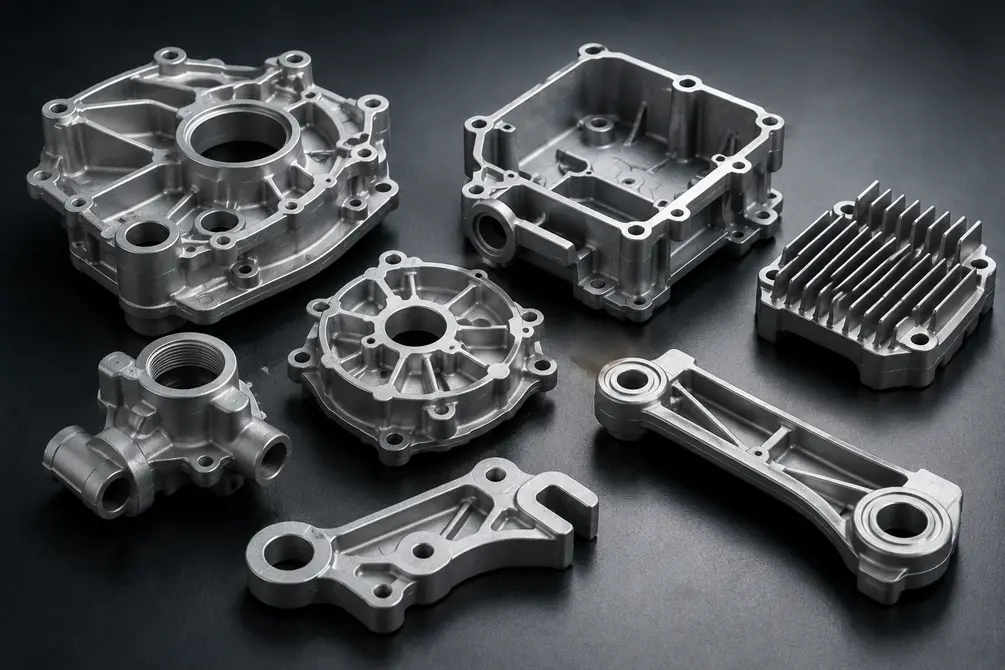
Cost control begins before any tooling commences. By considering your component’s casting, tooling, and subsequent manufacturing requirements during design, you can eliminate unnecessary expenditures arising from design changes during production.
It is possible to reduce manufacturing costs by improving die casting design in several ways:
- Tooling: Optimized casting design reduces the complexity of the tools required thereby reducing their cost, modifications, and maintenance.
- Material: Correct design reduces the amount of material used in production.
- Defects: Good component geometry minimizes the occurrence of casting defects.
- Scrap: Fewer defects mean higher-quality components with lower scrap rates during production.
- Machining: Thoughtful design of casting features reduces the need for extensive machining.
- Production time: The right design reduces the total time taken to produce each component.
- Inspection: Appropriate component tolerances can simplify inspection requirements and reduce unnecessary measurement and process-control costs.
The best opportunity to control die casting manufacturing costs is during the design stage. Once tooling begins, changes to the component design can result in significant redesign costs and tooling modifications.
Therefore, component design should be done with manufacturing in mind. This approach ensures that the design is not only fit for casting but also easy to machine, inspect, and assemble.
Contact Uni-Tech Casting to review your component design and suggest the necessary changes to your component’s geometry, material, or production requirements before tooling commences.
Conclusion
Avoiding the common die casting design mistakes discussed above can help you reduce the tooling, machining, and material costs while minimizing production time and defects. Draft angles, wall thickness, radii, tolerances, undercuts, and alloy selection all influence a component's manufacturability and production cost.
A cost-effective component design requires due consideration of these aspects to meet performance specifications while minimizing manufacturing expenditures.
Therefore, a component should be designed not only for its intended application but also for efficient casting, ejection, machining, and inspection. These considerations will help you reduce unnecessary expenses incurred during production.
Contact Uni-Tech Casting to discuss your component design and requirements. We offer professional casting services to help you manufacture cost-effective components.
FAQs
Common die casting design mistakes include insufficient draft angles, uneven wall thickness, unnecessary undercuts, sharp corners, tight tolerances, and overlooking secondary machining. Choosing an unsuitable alloy can also increase tooling, material, machining, and production costs.
Key die casting design considerations include draft angles, wall thickness, radii, undercuts, tolerances, alloy selection, and secondary machining. Ejection, inspection, and finishing requirements should also be considered to improve manufacturability and casting quality.
Poor die casting design can increase costs by making tooling more complex and requiring additional machining, inspection, or process control. Design changes after tooling begins can also lead to expensive die modifications and production delays.
Yes. Tight tolerances can increase die casting costs because they may require additional machining, inspection, and process control. Specify tighter tolerances only for critical dimensions that affect the part's fit, function, or performance.
Good die casting design can reduce tooling costs by simplifying part geometry, minimizing unnecessary undercuts, and using appropriate draft and radii. Designing for manufacturability before tooling begins can also help prevent costly die modifications.
Design for manufacturing ensures that a part can be efficiently cast, ejected, machined, inspected, and assembled. Considering these requirements early can reduce tooling changes, production issues, and overall manufacturing costs.