

Die Casting RFQ Checklist for OEMs and Procurement Teams
A complete die casting Request for Quotation (RFQ) helps OEMs and procurement teams obtain accurate, comparable quotes from manufacturers. It gives suppliers the technical specifications, production volumes, quality requirements, and commercial details needed to evaluate a project.
Missing information about drawings, materials, tolerances, tooling, machining, or delivery can lead to pricing assumptions, additional costs, and delays.
Use this die casting RFQ checklist to define your requirements upfront, reduce supplier clarification cycles, and make more informed sourcing decisions.
What Information Should a Die Casting RFQ Include?
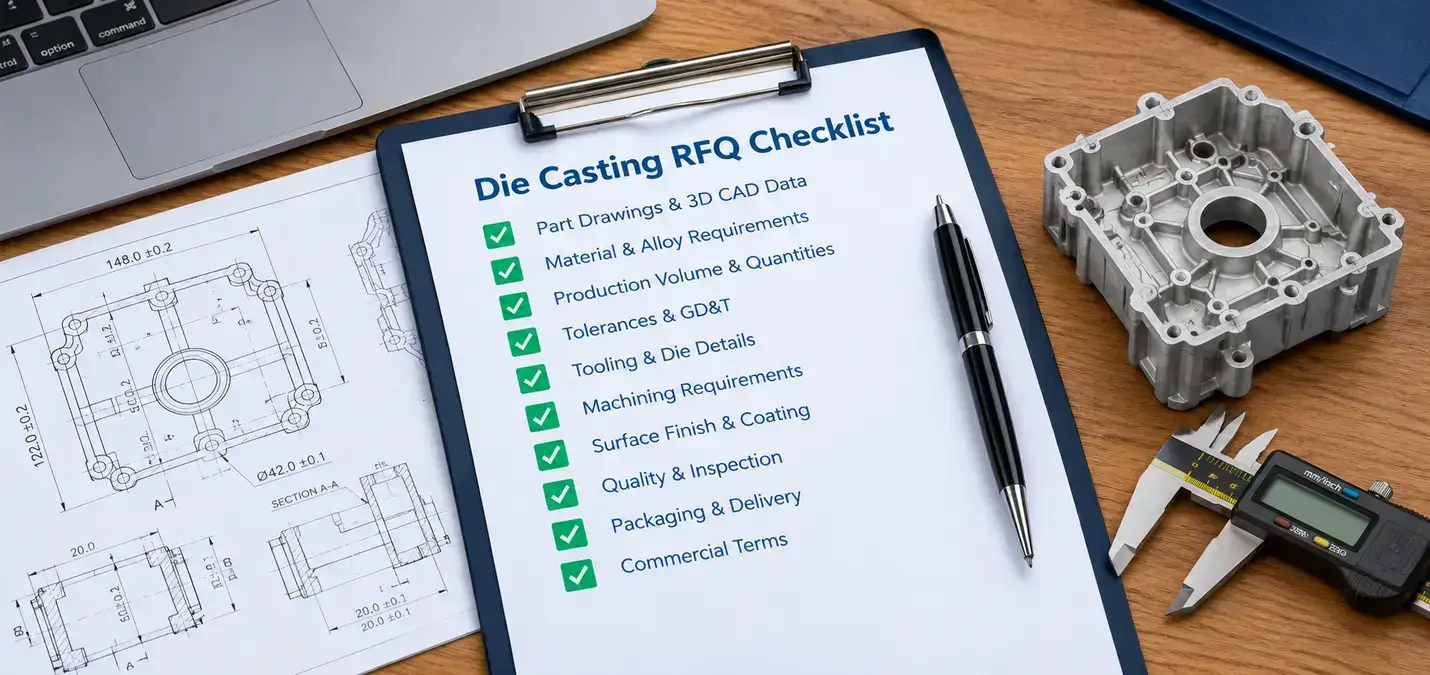
To obtain an accurate die casting quotation, provide the technical specifications, production requirements, quality standards, and commercial details suppliers need to assess your project. A 3D CAD model defines the component's geometry, while a 2D engineering drawing specifies dimensions, tolerances, datums, inspection requirements, and thread details.
The following table summarizes the key information to include in your die casting RFQ.
| RFQ Item | What to Provide | Why It Affects the Quote |
|---|---|---|
| Technical Files and Formats | 3D CAD model, 2D engineering drawing, and reference images or physical samples where applicable | Defines part geometry and acceptance requirements |
| Drawing Revision | Drawing number, issue date, revision level, and approval status | Prevents quotations based on outdated design information |
| Part Function | Application, mechanical loads, operating temperature, and environment | Guides material selection and manufacturing feasibility |
| Material and Alloy | Required alloy and applicable standard, or performance requirements if material selection is open | Affects material cost, casting behavior, and finishing requirements |
| Production Volume and Quantities | Prototype quantity, initial order quantity, annual volume, and program life | Influences tooling configuration, production planning, and unit cost |
| Critical Dimensions and Tolerances | CTQs, datum references, GD&T, hole tolerances, and inspection methods | Determines dimensional control, machining needs, and inspection scope |
| CNC Machining | Machined bores, flats, sealing surfaces, threads, and datum features | Affects machining time, fixturing, and inspection costs |
| Surface Finish and Appearance | Required finish, coating, color, cosmetic zones, and masking areas | Defines finishing processes and appearance acceptance criteria |
| Quality and Inspection | Dimensional reports, material certificates, leak testing, FAI, PPAP, or other applicable requirements | Determines testing, inspection, and documentation costs |
| Packaging and Delivery | Finished-part condition, delivery destination, packaging specifications, delivery schedule, and applicable Incoterms | Defines packaging, logistics, and delivery responsibilities |
Die Casting RFQ Checklist: Key Requirements
A complete die casting RFQ should cover component design, material selection, production volumes, tolerances, tooling, secondary operations, quality standards, packaging, delivery, and commercial terms.
The following sections explain what to specify in each area so manufacturers can assess feasibility and prepare quotations based on a consistent scope of work.
Part Drawings and 3D CAD Data
Provide the latest 2D engineering drawings and 3D CAD models, preferably in a format such as STEP. Ensure the 2D drawing and 3D model reflect the same design revision, and provide native CAD files if required by the supplier.
Drawings should include dimensions, tolerances, datums, thread details, and manufacturing specifications. Clearly identify the drawing number and revision level to prevent quotations based on outdated design information.
Material and Alloy Requirements
Specify the required alloy and applicable material standard, such as aluminum alloy A380 or zinc alloy Zamak 3, in accordance with the project's material specifications.
If material selection is open to recommendation, provide the component's performance requirements, including mechanical loads, operating temperature, and corrosion resistance. Material choice affects casting feasibility, cost, weight, and finishing requirements.
Production Volume and Quantities
State the initial order quantity, expected annual volume, batch size, and estimated program life. Include future demand forecasts where available.
These details help manufacturers determine tooling configuration, production capacity, and unit costs.
Tolerances and Critical Dimensions
Identify critical-to-quality (CTQ) dimensions, functional interfaces, hole positions, threads, and mating surfaces. Include GD&T requirements, datum references, and inspection methods.
Clearly distinguish as-cast tolerances from machined dimensions to establish achievable precision and avoid unexpected costs.
Tooling and Die Requirements
Specify whether new tooling, an existing die, or die modifications are required, along with tooling ownership, expected shot life, maintenance, and repair responsibilities.
For existing dies, provide available tool drawings, specifications, and usage history.
Machining and Secondary Operations
List all required post-casting operations, such as CNC machining, drilling, tapping, deburring, grinding, coating, and finishing.
Identify the features requiring machining and provide machining drawings where available to help suppliers estimate costs accurately.
Quality and Inspection Requirements
Specify applicable quality standards, certifications, inspection procedures, and required documentation. Depending on the application, these may include First Article Inspection (FAI), dimensional reports, material certificates, leak testing, X-ray inspection, porosity limits, or PPAP.
Specify acceptance criteria, inspection methods, and AQL levels where applicable.
Surface Finish and Appearance Requirements
Specify the required surface finish or treatment, such as powder coating, painting, anodizing, or bead blasting, and distinguish functional surfaces from cosmetic areas.
Include coating standards, masking requirements, acceptable cosmetic defects, and reference samples where necessary.
Packaging and Delivery Requirements
Specify the delivery destination, packaging type, quantity per package, shipment frequency, and required delivery schedule.
Include protective packaging and special handling requirements to prevent scratches, deformation, contamination, or transit damage.
Commercial and Procurement Requirements
Define payment terms, quotation validity, currency, delivery terms, production lead times, and applicable procurement conditions. Request a cost breakdown for tooling, casting, machining, finishing, and packaging.
Specify applicable Incoterms, insurance requirements, and procurement policies to establish clear commercial responsibilities and support like-for-like quotation comparisons.
Benefits of a Complete Die Casting RFQ
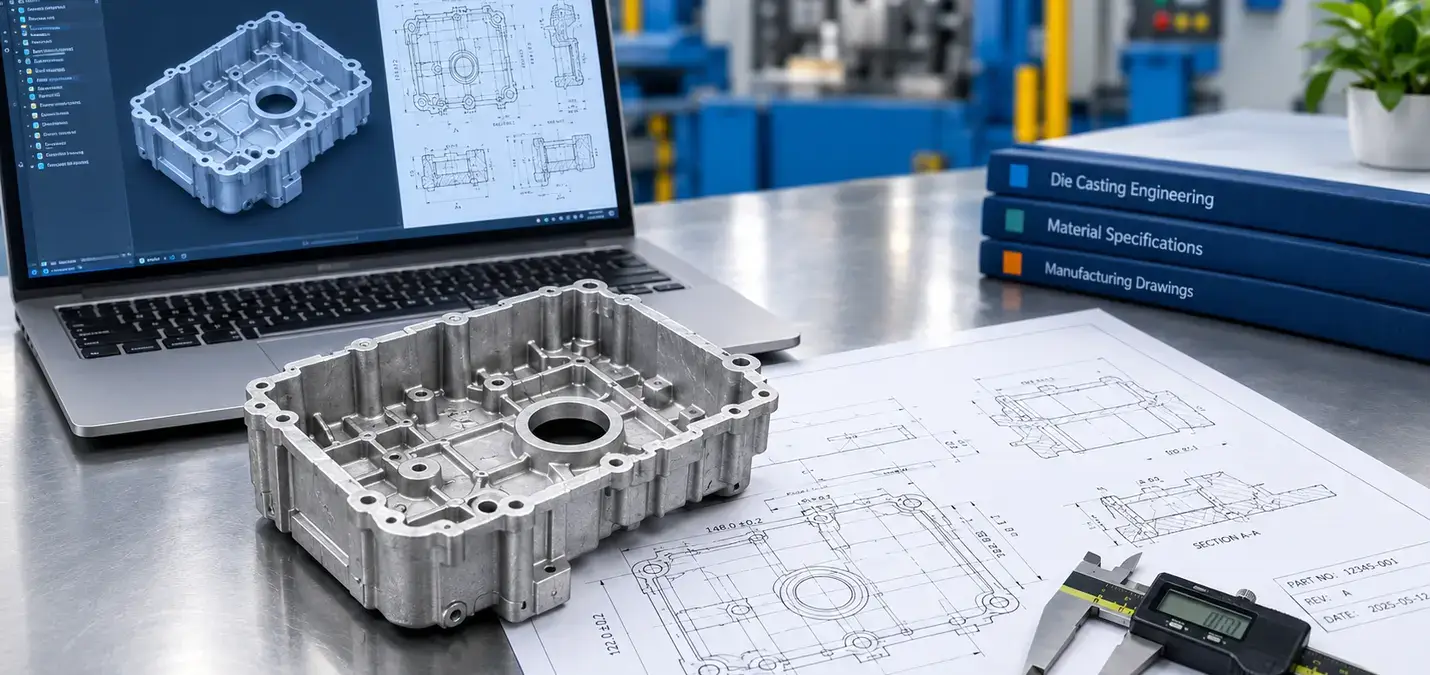
A complete RFQ helps die casting suppliers:
- Understand component specifications and functional requirements.
- Assess casting feasibility and tooling requirements.
- Estimate material, tooling, and production costs.
- Plan machining, finishing, and inspection processes.
- Identify quality documentation and testing requirements.
- Reduce assumptions and unnecessary clarification cycles.
- Prepare accurate, comparable quotations.
Common Die Casting RFQ Mistakes to Avoid
Common die casting RFQ mistakes include:
- Incomplete or outdated drawings: Missing dimensions, revisions, or conflicting CAD data.
- Unclear material specifications: No alloy designation, applicable standard, or defined performance requirements.
- Missing production volume details: No annual demand, initial order quantity, or program forecast.
- Undefined tolerances: Missing GD&T, critical dimensions, or inspection criteria.
- Omitted machining requirements: Unspecified holes, threads, sealing faces, or other machined features.
- Unclear surface finish requirements: No coating specifications, cosmetic zones, or acceptance criteria.
- Incomplete tooling requirements: Unclear ownership, maintenance responsibilities, or expected tool life.
- Missing quality requirements: Undefined testing, inspection reports, or approval documentation.
- Incomplete delivery and packaging details: No destination, packaging specifications, or delivery schedule.
- Missing commercial terms: Unspecified payment terms, quotation validity, or delivery conditions.
Conclusion
A well-prepared die casting RFQ helps manufacturers evaluate technical feasibility, determine tooling and production costs, and provide quotations based on clearly defined requirements. Before submitting your RFQ, ensure that your drawings, material specifications, production volumes, machining scope, quality requirements, and delivery terms are complete.
Need a die casting quotation? Share your 2D drawings, 3D CAD files, annual volume expectations, and key technical requirements with our team to discuss your project and obtain a quotation.
FAQs
RFQ stands for Request for Quotation. It's the formal document buyers send to manufacturers to obtain detailed pricing and project terms for parts manufacturing.
A die casting RFQ should include 2D drawings, 3D CAD models, material specifications, production quantities, critical tolerances, tooling requirements, machining and finishing operations, quality criteria, packaging, delivery details, and commercial terms.
A 3D CAD model provides the geometric and volumetric information suppliers need to evaluate material requirements, casting feasibility, tooling, and production processes.
Die casting manufacturers typically require a 3D CAD model along with a detailed 2D technical drawing that specifies material, tolerances, and post-processing requirements. Together, these help manufacturers evaluate the part and manufacture it correctly.
To obtain an accurate die casting quotation, submit the latest 2D engineering drawing and 3D CAD model, along with material specifications, expected production volumes, critical tolerances, tooling requirements, secondary operations, quality standards, and delivery expectations. Clearly define the required scope of supply and commercial terms so suppliers can quote consistently.