

Common Die Casting Defects and How to Prevent Them Effectively
Die Casting is a precision manufacturing process that produces quality metal components, but various manufacturing factors can lead to defects and affect the product's integrity and increase production costs. You must understand the common die casting defects and learn the prevention strategies to prevent them.
Manufacturing excellence in die casting requires the systematic identification and elimination of defects that occur at the various stages of the production process, from cold shuts and porosity to flash and dimensional variations. Each defect has different causes. You have to follow the proven prevention methods to maintain quality standards and reduce scrap rates. In this blog, we tell you the types of casting defects, causes, prevention strategies, etc.
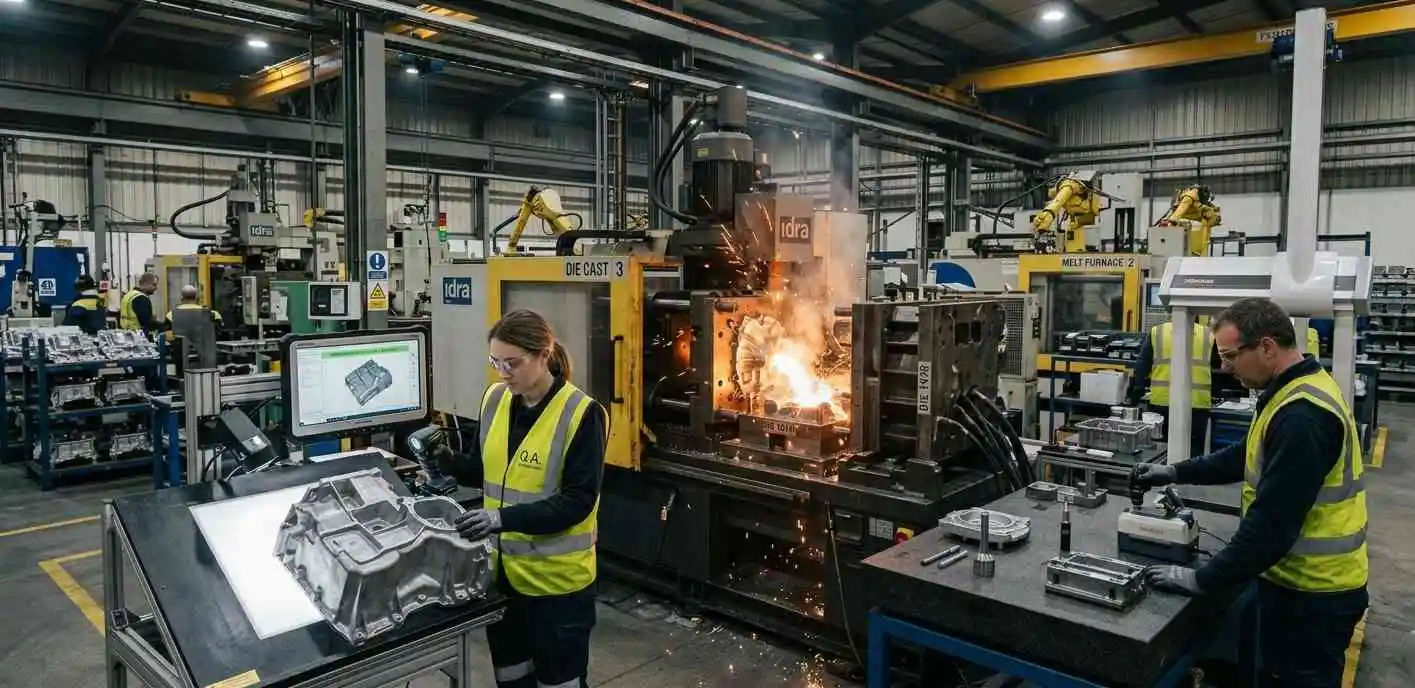
What are Die Casting Defects?
Die casting defects are imperfections or irregularities that occur during the die casting manufacturing process. These defects may appear on the surface of the component, within its internal structure, or in the form of dimensional inaccuracies.
Common defects can affect the strength, durability, appearance, and overall performance of the final product. Identifying and controlling these defects is essential to ensure consistent product quality, maintain manufacturing efficiency, and meet industry standards.
Importance of Preventing Die Casting Defects
You must prevent die casting defects to maintain the structural integrity, achieve precise dimensional tolerances, and ensure surface quality. By addressing defects in the die casting process like porosity, cracks, and cold shuts early on, manufacturers can avoid costly rework, cut down on raw material waste, and ensure reliable performance for the final components. Here are the reasons why preventing die casting defects is important:
Cost Reduction
Scrap parts, machine downtime, and post-cast rework processes such as welding or machining can significantly increase production costs. So it is important to prevent defects at the design stage to protect your finances.
Structural Reliability
Defects like shrinkage cavities and internal gas porosity can weaken the strength and ductility of parts. So it is important to prevent these issues earlier to ensure that components can handle stress, pressure, or extreme temperatures.
Flawless Surface Finishes
It is important to eliminate defects like flow marks and blisters to ensure that components look great from the mold and make the post-processing operations easier.
Process Efficiency
Preventing defects also improves production efficiency, reduces downtime, and extends component lifespan.
Common Die Casting Defects
Common casting defects affect the strength, appearance, and performance of finished components. You must understand these defects to spot quality issues early and take corrective actions to improve production consistency and lower rejection rates. Here are the common types of casting defects
Porosity
Porosity appears as small holes or voids within the casting due to trapped gas or shrinkage. It weakens the structure of the component and can lead to leaks or performance problems.
Shrinkage defects
Shrinkage defects occur when molten metal contracts while cooling and solidifying. These cavities can weaken structural integrity, impact dimensional accuracy, and affect the durability of the final product.
Cold shuts
Cold shuts happen when two streams of molten metal don't fuse correctly inside the mold. This creates visible lines and weak points that compromise strength.
Misruns
Misruns occur when molten metal solidifies before fully filling the mold cavity. This results in an incomplete casting that doesn't meet the required specifications.
Surface defects
Surface defects include cracks, blisters, rough finishes, and discoloration. They impact the product appearance, raise finishing costs, and may signal deeper process problems.
Air entrapment
Air entrapment occurs when air gets trapped during metal injection. It creates internal voids that reduce component strength and raise the risk of porosity.
Causes of Die Casting Defects
There are various factors that lead to die casting defects. Manufacturers should understand these causes to fine-tune production parameters, improve process control, and consistently produce high-quality castings with fewer quality issues. Let us look at the causes below.
Improper temperature control
It can affect the flow and solidification of molten metal, leading to defects like porosity, cold shuts, shrinkage cavities, and surface flaws.
Incorrect injection pressure
Incorrect injection pressure, whether too low or too high, can interfere with mold filling. Poor pressure control often results in air entrapment, misruns, incomplete filling, and dimensional inconsistencies.
Poor mold design
Poor mold design, such as improper gate placement, insufficient venting, and uneven cooling channels, can hinder metal flow. This increases the risks of casting defects and quality issues.
Material Impurities
Using contaminated or low-quality raw materials can introduce inclusions and surface defects. Material impurities decrease mechanical properties and affect the overall casting quality.
Incorrect machine settings
Incorrect machine settings, like injection speed, holding pressure, and cycle time, can affect the production and result in inconsistent quality and more defect occurrences.
Lack of Process Monitoring
Without continuous monitoring, defects in the die casting process may go unnoticed. This can allow defects to develop during production, raising rejection rates and manufacturing costs.
How to Prevent Die Casting Defects
Here are some effective strategies to prevent die casting defects:
Optimizing mold design
Optimizing mold design is vital for reducing defects. Use proper venting systems, adjust gating for correct metal flow, and ensure accurate mold alignment to lower the risk of flash and porosity.
Control Process Parameters
Maintaining consistent temperatures, pressures, and cooling rates is key to making sure molten metal fills the mold correctly and solidifies without defects.
Material Selection
It is suggested to use high-quality, preheated materials to reduce defects. By ensuring the proper storage and handling, you can avoid moisture-related problems.
Equipment Maintenance
Regular maintenance and calibration of dies, machines, and tooling support consistent quality and help lessen defects.
Training and Expertise
Well-trained operators are crucial for spotting potential defects early and taking swift corrective actions. They need to grasp the details of the process and know how to adjust parameters when necessary.
Advanced Techniques to Reduce Defects
Modern die casting facilities are leveraging advanced technologies to reduce defects and improve product quality. These techniques enable manufacturers to manage important process variables, reduce mistakes, and achieve consistent, defect-free castings with better structural integrity and performance.
Vacuum-Assisted Die Casting
This technique removes trapped air and gases from the die cavity before metal injection. It helps reduce defects in the die casting process, avoids internal porosity, improves density, and enhances pressure-tightness. Hence, it creates stronger components with better mechanical properties and overall casting quality.
Casting Simulation and Modeling
Casting simulation software like MAGMA and ProCAST assesses molten metal flow, solidification patterns, and thermal behavior before production starts. It can easily identify the cold shuts, shrinkage, and gas entrapment issues, thus reducing costly design changes.
Precision Thermal Management
Another technique used to prevent die casting defects is precision thermal management. It uses localized cooling systems to keep consistent die temperatures during production. This helps eliminate hot spots and control solidification rates, effectively reducing soldering, warping, hot tearing, and shrinkage defects.
Shot Control and Velocity Profiles
These techniques involve advanced systems that manage plunger movement and metal injection speed throughout the casting cycle. Controlled velocity profiles lower turbulence, reduce air entrapment, enhance mold filling, and ensure steady production of high-quality components.
Design of Experiments (DOE)
DOE is a statistical approach used to optimize several process parameters at once. It finds the best combination of temperature, pressure, and injection speed, lowering defects while improving process stability and efficiency.
Conclusion
Die casting is a crucial manufacturing process that presents inherent challenges. By recognizing the types of defects, identifying their causes, and applying preventive measures, manufacturers can improve the quality and consistency of their products. By investing in advanced technologies, optimizing processes, and ensuring operator training, you can easily reduce defects and achieve a smooth die-casting operation.
Frequently Asked Questions
Common die casting defects can impact the surface finish and structural integrity of the component. They occur due to improper mold temperature, gas entrapment, faulty die design, and incorrect injection speed.
Die casting defects are caused by improper injection speeds, trapped gas, poor mold design, and incorrect thermal management. It causes structural and surface flaws and affects the appearance and integrity of the casting part.
Porosity in die casting is the formation of small internal voids, surface cavities, and air pockets during the solidification of molten metal. It causes pressure leaks, weakens structural integrity, and affects surface finish.
Quality control (QC) plays a vital role in preventing defects and acts as a detection mechanism. It helps detect issues early in raw materials or during production, and stops faulty items from leaving the facility. It also eliminates the high costs of recalls, rework, and waste.
Uni-Tech Casting ensures defect-free production through the multi-stage quality control system. It integrates the advanced simulation tools, stringent material testing, automated process controls, and post-casting dimensional verification, helping prevent defects such as porosity, shrinkage, and dimensional variations.
Read more: High-Pressure Die Casting: Complete Guide