

High-Pressure Die Casting: Complete Guide
High-pressure die casting is a popular manufacturing process known for producing lightweight, strong, and complex metal parts with high precision. It is used in industries like aerospace, automotive and medical equipment manufacturing, where accuracy, durability and efficiency are essential.
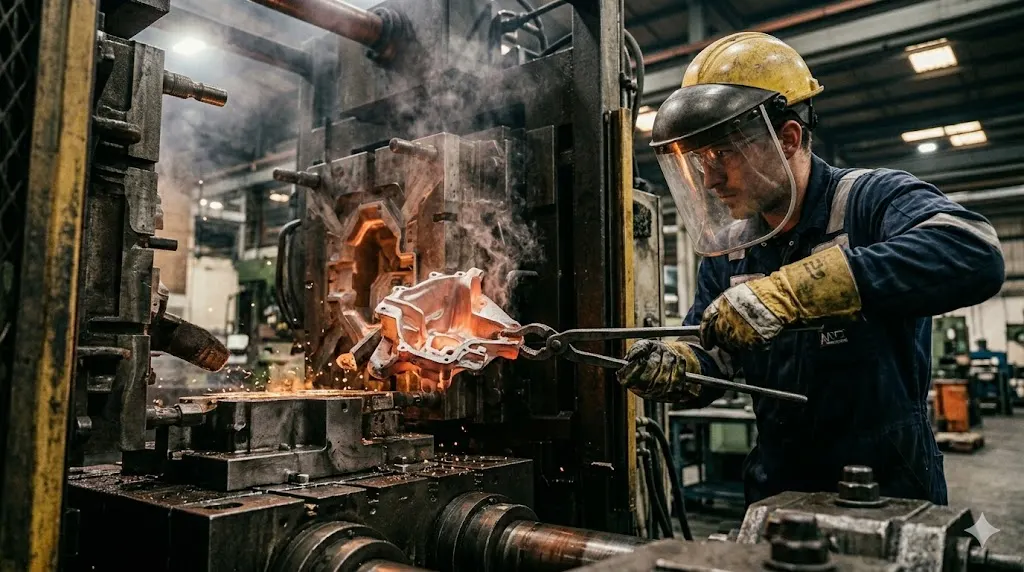
In this blog, we explain high-pressure die casting, its working principles, benefits, HPDC process and applications.
What is High-Pressure Die Casting?
High-pressure die casting is the manufacturing technique where the molten metal is forced into a mold and dies at substantial pressure to create components. This process achieves high-dimensional precision, smooth surface finish and tight tolerances. It eliminates the necessity for secondary processing steps. Manufacturers prefer HPDC over other processes because of speed, cost effectiveness and capacity for high volume output.
High-Pressure Die-Casting Process
The HPDC process involves various stages, and each stage impacts the final quality of the die casting products. These steps consist of the following:
Mold Preparation
Before starting casting, the die or mold is prepared. It includes the cleaning, preheating and applying lubricant to the die surface. Preheating is important to ensure that the metal flows properly during injection.
Injection of Molten Metal
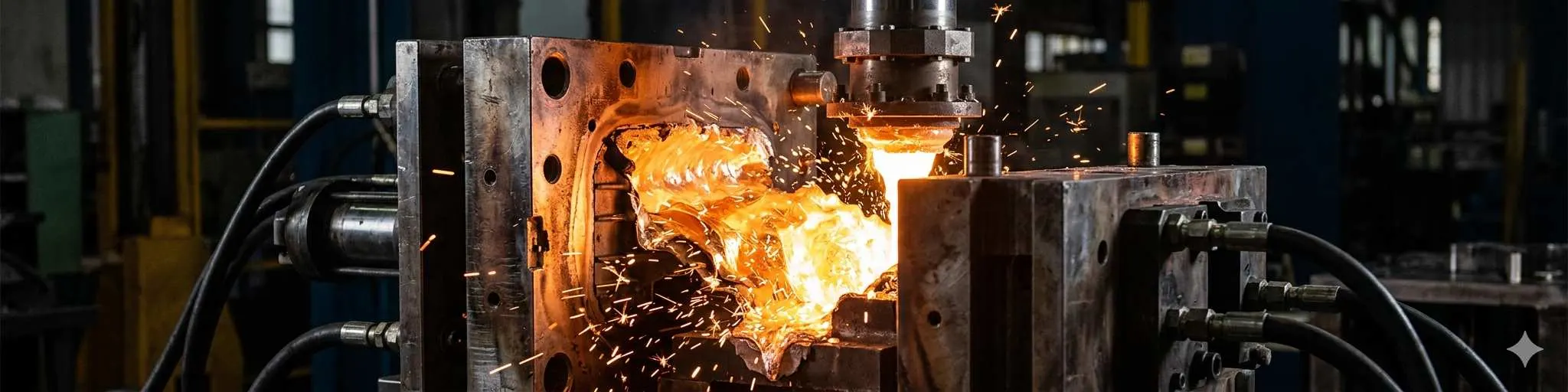
After preparing the mold, molten metal is injected into the mold cavity at high pressure. It is an important step because pressure fills all parts of the cavity, including small details. The injection pressure ranges from 1,500 to 25,000 psi on the basis of part design and metal.
Cooling and Solidification
After metal is injected, it starts cooling and solidifies in the mold. The cooling rate is controlled by the material being cast and the mold design. In High-pressure die casting, cooling happens quickly because of the direct contact between the molten metal and the steel mold, allowing short cycle times.
Ejection and Finishing
After the part solidifies, it is ejected from the mold. Ejector pins help remove the part without harming its surface. After ejection, parts often undergo post-processing, such as trimming, deburring, and surface finishing, to meet required specifications.
Materials Used in High-Pressure Die Casting
HPDC uses aluminum, zinc, and magnesium alloys, each offering distinct benefits depending on the application.
Aluminum die casting is used because of its strength-to-weight ratio, thermal management, and resistance to corrosion.
Zinc die casting is popular because of its surface finish, dimensional accuracy, and fine detail.
Magnesium die casting is the lightest option used for producing weight-sensitive components.
Benefits of High-Pressure Die Casting
HPDC is a well known manufacturing process across industries. This is due to its many advantages compared to other manufacturing processes. Here are the key benefits of High-pressure die casting:
High Production Efficiency
It allows for quick cycle times and makes it suitable for mass production. It is faster than low-pressure die casting and gravity casting.
Excellent Dimensional Accuracy
This HPDC process creates a highly precise component with limited machining needs. It is suitable for aerospace and automotive applications, where tight tolerances matter.
Smooth Surface Finish
High-pressure injection leads to fine surface textures, minimizing the need for extra finishing. It makes plating and painting easier.
Produce Thin-Walled Components
It creates thin-walled parts (less than 0.40 mm thickness), reducing material use and weight. It is used in lightweight automotive and aerospace applications.
Strength and Durability
It produces stronger parts compared to other casting methods. It makes it ideal for components that face high mechanical stress.
Cost-Effectiveness
The reusability of molds and high-speed production make HPDC cost-effective for large-scale production. There is less waste because scrap metal can be recycled.
Applications of High-Pressure Die Casting
The High-pressure die casting process is used to manufacture quality components. It is widely used in the industries given below.
Automotive
Aluminum alloy and zinc HPDC are widely used in the automotive sector to produce automotive parts such as transmission housings, engine blocks, and mounting brackets. This process is preferred because it produces lightweight yet strong components, improving vehicle handling and fuel efficiency.
Aerospace
In aerospace, HPDC is used to create lightweight structural components where the strength-to-weight ratio is crucial.
Electronics and Consumer Goods
HPDC is also used in electronics and consumer goods to produce laptop and smartphone housings. These components require good surface finishes, fine details and high volume production, and HPDC handles it well.
Medical Equipment
The medical industry also relies on HPDC because it is biocompatible and precise in dimensions. Due to its dimensional accuracy and repeatability properties, it is used to produce the diagnostic device enclosures, surgical tools and other medical parts.
Common Defects and Solutions
Even with some benefits, High-pressure die casting can have some common defects. You must be aware of these defects and follow the solutions to resolve them.
| Defect | Description | Cause | Solution |
|---|---|---|---|
| Porosity | Small air pockets or voids in the casting | Shrinkage or Trapped gas while cooling | Control injection speed, improve venting, and optimize cooling process |
| Cold Shuts | Lines or weak spots where molten metal fails to fuse properly | Slow mold filling or Low metal temperature | Improve injection speed and increase melt temperature |
| Air Entrapment | Air bubbles trapped in the casting | Turbulent metal flow during injection | Reduce turbulence in molten metal flow and improve gating design |
| Flash Formation | Excess metal leaks out along the mold edges | Worn molds or Poor die alignment | Maintain dies regularly and ensure proper clamping force |
| Misruns | Incomplete filling of the mold cavity | Insufficient molten metal flow or low pressure | Maintain proper metal temperature and increase injection pressure |
Why Choose High-Pressure Die Casting?
Manufacturers use the HPDC process because it offers precise, durable, and cost-effective components at large-scale production. It serves various industries that require lightweight, strong and complex metal parts. Here's why you can choose HPDC
Precision Manufacturing
It produces highly accurate parts with tight tolerances and is suitable for industries that require exact dimensions and reliable consistency in every manufacturing batch.
High Production Speed
It facilitates the fast casting cycle and allows the manufacturers to produce the same parts rapidly. Hence, it reduces turnaround times and enhances efficiency in large manufacturing environments.
Excellent Consistency
Each component produced by HPDC maintains the uniform size, shape and quality. It ensures the reliable performance across all manufactured components with variations.
Complex Design Capability
High-pressure casting benefits produce intricate shapes and detailed geometries in one step, reducing the need for extra machining or assembly after casting.
Cost-Effective for Large Volumes
Another reason why manufacturers prefer High-pressure die casting because of cost effective production of large volumes. Even though initial tooling costs are high, the low per-unit cost in mass production makes HPDC economical in the long run.
Durable and Strong Components
Parts made through HPDC exhibit excellent mechanical strength, suitable for demanding applications in automotive, electronics, machinery, and industrial sectors.
High-Pressure Die Casting at Uni-Tech Casting
At Uni-Tech Casting, we focus on High-pressure die casting (HPDC) and provide you with efficient casting solutions for various industries. Our skilled team and technology allow us to produce high-quality metal parts with precision and consistency.
Contact us for a consultation and a customized quote. We are dedicated to providing you with superior quality and efficiency in your manufacturing process.
Conclusion
High-pressure die casting has become essential in modern manufacturing due to its speed, precision, and efficiency. From consumer electronics to automotive engine parts, the HPDC process allows manufacturers to create strong, lightweight, and complex metal components at scale.
With many benefits like reduced waste, consistent quality, and fast production cycles, HPDC continues to influence the future of industrial manufacturing. As technology advances, this process will remain vital for producing durable, high-quality metal parts worldwide.
FAQs
High-pressure die casting is used to produce the smooth, intricate and precise finished parts in large quantities. It is widely used for its speed, excellent surface finish, dimensional accuracy, cost effectiveness and reduced need for secondary processing.
HPDC provides various benefits in the manufacturing industry, including high automation, faster cycle times, and superior dimensional protection. It is suitable for mass production and complex geometries, and reduces per-unit costs.
The common materials used in HPDC are zinc, aluminum, copper alloys, tin and lead. Each material offers unique benefits and enables optimal performance in your industrial applications.
HPDC operates at a pressure range from 1500 to 30,000 PSI. This high pressure enables molten metal to fill the mold evenly and quickly.
The cycle time of HPDC ranges from 15 seconds to 1 minute. This process is optimized for speed and allows for the high-volume production with die lubrication, solidification and clamping that complete within 50 seconds, depending on part material and complexity.