

Types of Casting Processes in the Manufacturing Industry
In the dynamic manufacturing industry, casting remains a vital process to transform raw materials into intricate components with tailored mechanical properties. From turbine blades to automotive engine blocks, casting supports various industries with scalability.
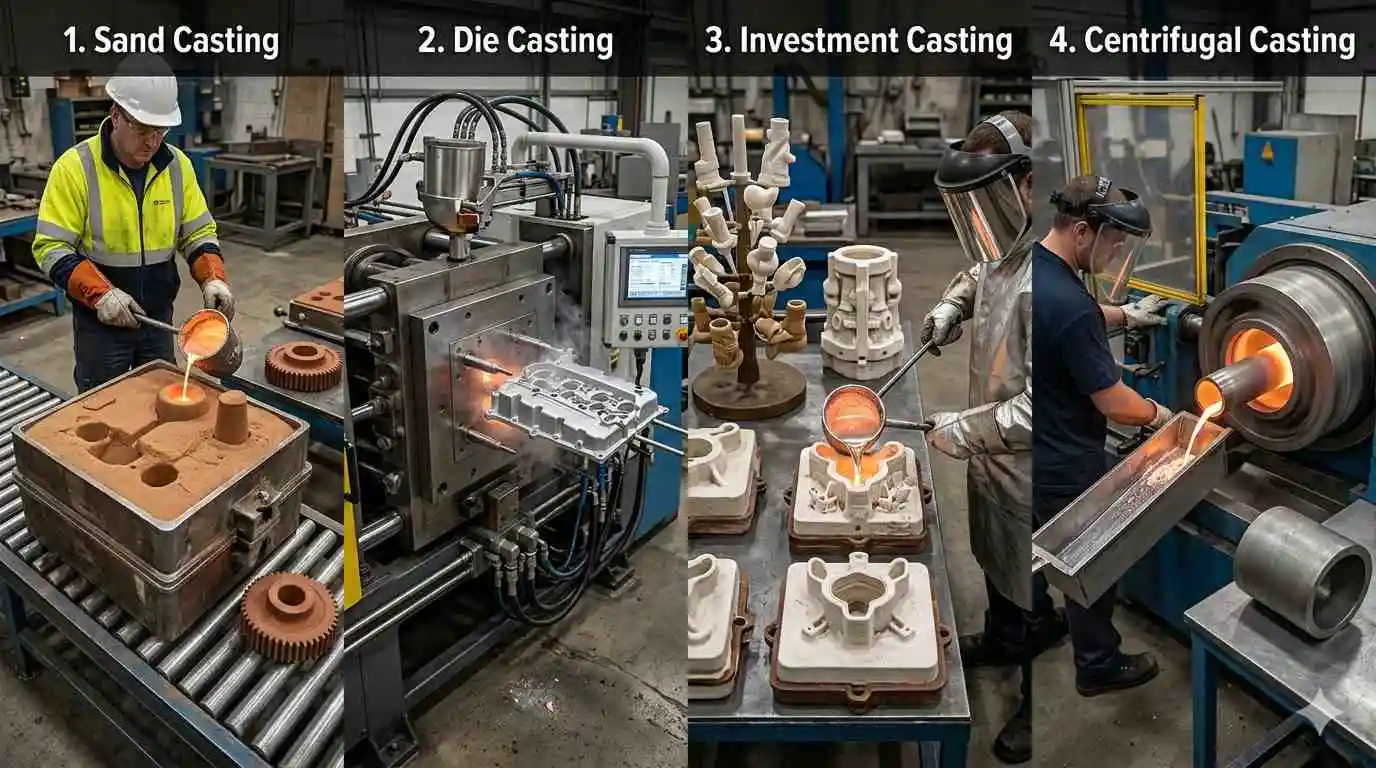
As the demands shift towards precision, lightweight, and sustainability, various casting methods have evolved to fit specific material and economic needs. In this blog, we explain the different types of casting methods in the manufacturing industry with their benefits and drawbacks.
What is Casting in Manufacturing?
Casting is one of the oldest manufacturing processes and involves pouring molten metal into a shaped cavity, which is called a mold. It cools and solidifies into a desired shape and is then extracted as a final product, followed by finishing and machining to achieve precision and tight tolerances.
Importance of Casting Processes in Industry
Casting is beneficial for mass production and prototyping. It handles the different alloys, complex shapes, and various sizes, from a few grams to several tons. It makes it suitable for industries like automotive, aerospace, medical, and energy.
- Prototyping: Fast casting techniques, such as 3D-printed molds, allow quick changes during product development.
- Mass Production: It is suitable for high-speed die casting and continuous casting and creates thousands of parts with consistent quality.
Different Types of Casting Processes in Manufacturing
Casting is one of the oldest manufacturing techniques, but modern advancements lead to specialized casting methods. Hot forming processes such as die casting, investment casting, plaster casting, and sand casting each offer unique benefits. Comparing the pros and cons of common casting types helps in choosing the best method for a production run. Here are the different types of casting methods used
Sand Casting Process
The sand casting process uses silica-based materials like synthetic or naturally-bonded sand. It consists of finely ground, angular grains that pack together and create the smooth mold surface. The sand mold allows for some shrinkage during cooling and reduces internal stresses and cracking. Adding clay can strengthen the sand by helping the particles bond more closely. Products like engine blocks are made through sand casting.
Die Casting Process
The die casting process is used to mold materials under high pressure, involving non-ferrous metals and alloys like zinc, tin, copper, and aluminum. It creates the reusable mold and coats it with lubricant to help control temperature and assist with ejecting parts.
Molten metal is injected into the die under high pressure until the workpiece solidifies. This process prevents any part of the material from hardening before being cast.
Investment Casting Process
Investment casting uses a disposable wax pattern to create parts. The wax is coated with a refractory material to form a hard shell, then melted out in an oven. Molten metal is poured into the hollow mold and solidified. Finally, the shell is broken away to reveal the finished component. It is commonly used for high-precision parts in automotive, aerospace, and power generation industries, such as turbine blades.
Gravity Die Casting Process
Gravity die casting, also called permanent mold casting. It uses fabricated metals and alloys during casting and creates reusable molds made of metals like steel or graphite. It produces various items, including gears, gearboxes, hose fittings, wheels, and engine pistons.
Centrifugal Casting Process
Centrifugal casting, often called roto casting, uses centrifugal forces to create cylindrical parts for industrial use. In this method, molten metal is poured into a preheated, rotating die. Centrifugal forces aid in distributing the molten metal throughout the die under pressure.
Continuous Casting Process
This casting process allows for the mass production of metal profiles with consistent cross-sections and also manufactures steel bars. Additionally, the vertical cast produces semi-continuous castings like billets, ingots, bars, and similar items.
Comparison of Different Casting Processes
Here is a comparison of different types of casting processes, along with their benefits, drawbacks, applications, and cost factors
| Types | Advantages | Limitations | Cost-Effectiveness | Application |
|---|---|---|---|---|
| Die Casting | Excellent surface finish, precision, complex shapes, and fast production rates | High initial tooling costs, Limited to non-ferrous alloys | Cost-effective for mass production | Electronics housings, Automotive components, consumer goods, industrial components |
| Investment Casting | Excellent surface finish, precision, and produce intricate and complex components | Higher costs than other casting process, Slower production rate | Moderate to high costs | Medical tools, Aerospace components, jewelry |
| Sand Casting | Versatile, wide material compatibility, ideal for large parts, low tooling cost | Lower surface finish and precision than other casting methods | Cost-effective, suitable for low to medium volume production | Machine bases, pipe fittings, Engine blocks, industrial tools, and agricultural equipment |
| Gravity Die Casting | Improved surface finish, Better mechanical strength, reusable molds, reduced porosity | Higher tooling cost than sand casting, less design complexity | Cost-effective, suitable for medium to high-volume production | Cylinder heads, Automotive wheels, industrial components |
| Centrifugal Casting | Produces strong, dense, defect-free cylindrical parts with good mechanical properties | High initial equipment cost, Limited to cylindrical shapes | Moderate costs, used to create cylindrical parts | Rings, tubes, Pipes, bushings, pressure vessels, cylindrical components |
| Continuous Casting | Consistent quality, high production rate, less material waste, automated process | Very high initial investment, limited to simple cross-section shapes | High cost initially, but very cost-effective for large-scale production | Slabs, sheets, Steel billets, blooms, rods, rails, large-scale metal production |
Applications of Casting Processes in the Manufacturing Industry
Casting is widely used across industries because it produces durable, precise, and cost-effective metal components. Different casting methods are used on the basis of size, strength, complexity, and production needs of industrial applications. Here are the applications
Automotive Industry
Casting processes are used in the automotive sector and create engine blocks, transmission housings, wheels, brake components, and EV parts. Die casting and gravity casting efficiently produce lightweight and durable automotive components.
Aerospace Industry
Investment casting is used in the Aerospace industry to make lightweight aircraft parts, brackets, turbine blades, and structural parts. It ensures high-dimensional accuracy, strength, and reliable performance in critical applications.
Construction Industry
It is also used in the construction industry to produce fittings, pipes, structural supports, industrial valves, and heavy equipment parts. Sand casting is often preferred as it suits large and robust metal parts.
Machinery and Industrial Equipment
It uses casting to create pump bodies, compressors, gear housings, machine bases, and valve components. Casting makes it possible to produce complex industrial parts with great durability and long operational life.
Consumer Goods Industry
Consumer product manufacturers use casting to produce cookware, furniture hardware, decorative items, lighting fixtures, and appliance components. Casting enables smooth finishes, attractive designs, and cost-effective mass production.
Advantages of Using Casting in Manufacturing
Casting is a popular manufacturing method because of its efficiency, flexibility, and cost savings. Modern industries use casting to create components with complex shapes, strong materials, and consistent quality in large volumes. Here are its advantages
Design Flexibility
It is used to create complex shapes, thin walls, and intricate inner structures easily, which is hard to achieve through welding, machining, and fabrication.
Cost Efficiency
Another benefit of casting is that it reduces manufacturing costs by reducing material waste, lowering machining needs, and enabling faster production cycles. It becomes affordable for medium and high-volume production.
Mass Production
Processes like die casting and continuous casting support quick and repeatable manufacturing of identical parts with consistent quality, making casting ideal for large-scale production.
Ability to Create Complex Shapes
Casting can produce parts easily with detailed geometries, internal cavities, curved designs, and fine surface details that are difficult with traditional manufacturing methods.
Material Compatibility
Casting is compatible with many types of metals and alloys such as steel, iron, aluminum, copper, brass, and magnesium. It gives manufacturers the flexibility to choose materials based on specific application requirements.
Production of Large Components
It is also beneficial to make large industrial parts like engine blocks, machine bases, pipes, and construction equipment components, which can be challenging to produce using other methods.
Conclusion
Casting is one of the most important manufacturing processes in modern industries. Different casting methods enable manufacturers to produce components with varying levels of precision, strength, complexity, and production volume. From sand casting and die casting to investment casting and continuous casting, each method offers unique advantages for specific industrial applications.
Uni-Tech Casting Pvt. Ltd. delivers reliable casting solutions tailored to meet diverse industrial requirements with a strong focus on quality and precision.
FAQs
The different types of casting processes are die casting, sand casting, investment casting, continuous casting, gravity die casting, and centrifugal casting.
Sand casting is the most reliable method because of its flexibility, low cost, and suitability for large components.
The difference between sand casting and die casting lies in the material used for the mold. Sand casting is suitable for low-volume or large parts, whereas die casting uses permanent metal molds for high-volume production.
Die casting is a suitable method for mass production because of its production efficiency and high speed.
Casting processes are categorized into two main groups on the basis of the nature of the mold used, expendable mold casting and non-expendable (or permanent) mold casting.