

Role of Quality Control in the Die Casting Industry
Quality control is an important stage in the die casting manufacturing process. It is important to perform the Die Casting Quality Control process to ensure that the products are free from defects and meet the necessary standards. There are various tests and procedures used to assess the casting's quality. It includes mechanical testing, dimensional verification, visual inspection, and other testing procedures.
By ensuring that the products meet the quality standards, manufacturers can reduce costly recalls and customer complaints. In this blog, we tell you the importance of quality control in the die casting industry, the stages and technologies involved, and the benefits of a strong quality control system.
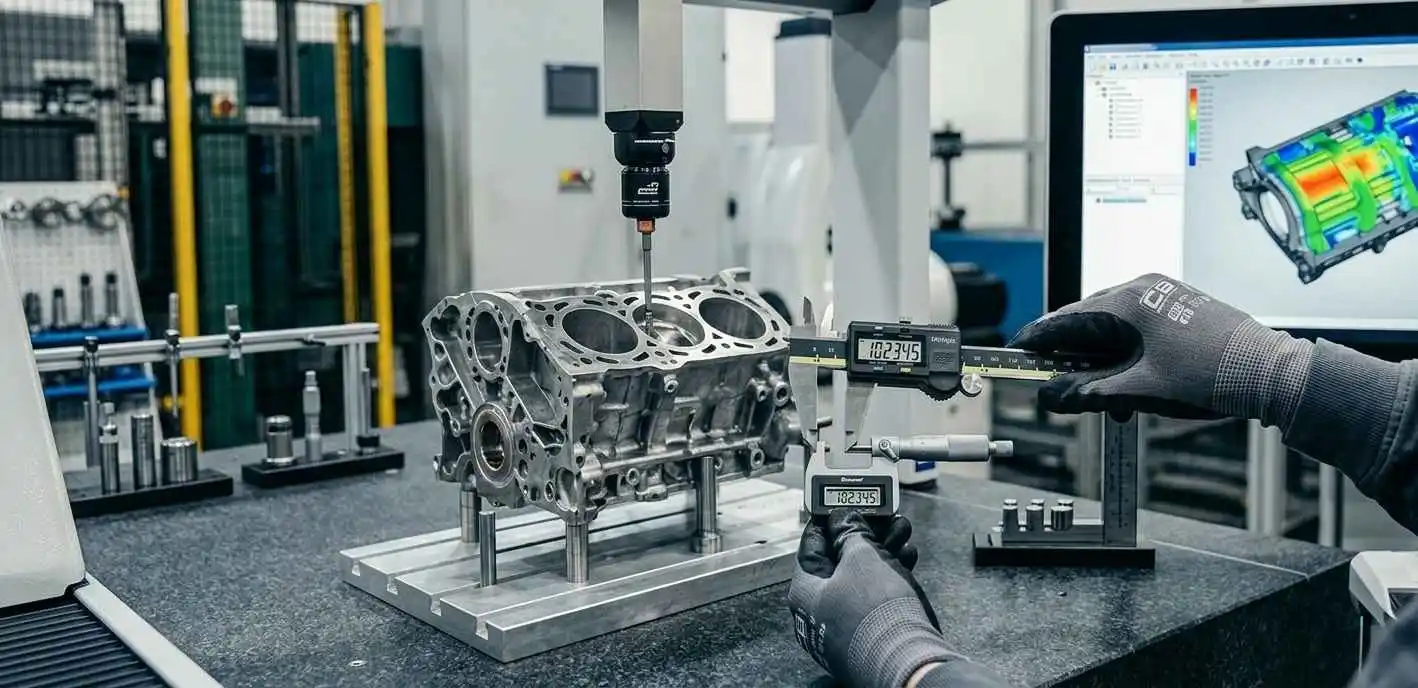
What is Quality Control in Die Casting?
Quality control in die casting is a systematic process of monitoring, inspecting, and evaluating every stage of production to ensure that die-cast components meet specified quality standards. It focuses on maintaining dimensional accuracy, mechanical strength, surface finish, and product consistency while minimizing defects and production variations.
Effective quality control helps manufacturers deliver reliable, high-performance components that meet industry and customer requirements.
Importance of Quality Control in the Die Casting Industry
Product Consistency
The die casting process requires producing large quantities of identical parts. So it is important to maintain consistency in surface finish, dimensions, and mechanical properties. This highlights the importance of quality control measures, regular inspections, dimensional measurements, and material testing, to maintain consistency.
Defect Minimization
The die casting industry operates in areas where safety and reliability are critical. Any defects in the components could lead to serious consequences. So, following die casting quality control practices, including real-time monitoring and process optimization, is important to reduce defects.
Cost Efficiency
Finding and fixing defects in later production stages can be very expensive. By implementing quality control measures from the beginning, manufacturers can identify issues early, reducing the need for rework or component rejection.
Customer Satisfaction
Because meeting customer expectations is important in the casting industry, quality control matters. It satisfies customers and improves the industry's reputation for excellence.
Stages of Quality Control in Die Casting
Quality control in the die casting industry not only includes inspection, but also other stages. Here are the stages it involves.
Raw Material Inspection
It starts with inspecting incoming raw materials. The chemical composition, purity, and mechanical properties of metals such as aluminum, zinc, magnesium, or copper alloys must meet specified standards.
Monitoring Casting Parameters
It also includes the monitoring of critical process parameters to maintain consistency. The important parameters include molten metal temperature, injection pressure, injection speed, die temperature, cooling time and cycle time.
In-Process Inspection
The next stage is in-process inspection. It is performed during manufacturing to catch issues before producing large quantities of defective parts.
Post-Production Inspection
Now the components undergo a detailed inspection to verify that they meet the design specifications.
Final Testing and Product Approval
Before shipment, finished products undergo final testing and quality verification.
Die Casting Quality Control Techniques Used in Industry
Visual Inspection
Visual inspection is one of the most basic and important Die Casting Quality Control techniques.
Dimensional Measurement Tools
Accurate dimensions are critical for die-cast components. Manufacturers rely on precision measurement tools to check dimensional accuracy.
X-Ray Inspection
Many internal defects go undetected through visual inspection. X-ray inspection is a widely used technique in automotive and aerospace applications.
Statistical Process Control (SPC)
Statistical Process Control involves collecting and analyzing production data to monitor process performance.
Automated Inspection Systems
Modern manufacturing facilities use automated inspection technologies integrated with production lines.
Benefits of a Strong Quality Control System
Lower Scrap and Rework Costs
Early detection of flaws through X-ray, ultrasonic testing, or visual inspections stops defective parts from moving to machining or assembly, saving raw materials and labor costs.
Dimensional Accuracy
Regular tool inspections and CMM checks confirm all cast components match exact CAD tolerances.
Enhanced Structural Integrity
It maintains melt quality, monitors mold temperatures, and reduces shrinkage and internal porosity, resulting in durable, high-strength parts.
Process Optimization & Efficiency
Data from real-time monitoring systems helps identify the root causes of inefficiencies.
Maintained Brand Reputation
By eliminating flawed products, manufacturers avoid costly recalls, prevent supply chain disruptions, and build long-term customer trust.
FAQs
Quality control is the systematic process of monitoring and inspecting every production stage to ensure that each part is free from defects and meets design specifications.
Quality control is important because it ensures dimensional accuracy, structural integrity, and defect-free products while reducing waste and production costs.
The main stages include raw material inspection, process monitoring, in-process inspection, post-production inspection, and final product testing.
Common inspection methods include visual inspection, dimensional measurement, X-ray inspection, non-destructive testing (NDT), and mechanical testing.
Quality control reduces defects, minimizes waste, lowers rework costs, improves process efficiency, and increases customer satisfaction.
Read more: High-Pressure Die Casting: Complete Guide